
A sudden drop in organic traffic can be alarming, especially when your website has been performing well for months or even years. One of the first explanations many website owners hear is, “Your site has a Google penalty.” But a ranking decline does not automatically mean Google has penalized your website.
Google uses automated systems and manual reviews to identify websites that violate its spam policies. Depending on the issue, a site or specific pages may experience lower visibility or may be removed from search results altogether.
Understanding what actually happened is the first step toward fixing the problem. In this guide, we will explain what a Google penalty means, how to identify one, what commonly causes penalties, and how to approach Google penalty recovery without making the situation worse.
What Is a Google Penalty?
A Google penalty generally refers to a negative search visibility impact caused by a website violating Google’s search spam policies. Google describes these violations as practices intended to deceive users or manipulate search systems to gain better visibility.
There are two important situations to understand.
The first is a manual action. This happens when Google’s team determines that a website or specific pages violate its guidelines. A manual action can affect part of a website or a much larger portion of it. Website owners can check for manual actions through Google Search Console.
The second is an algorithmic or automated demotion. Google’s automated systems continuously evaluate websites and search results. If those systems detect spammy or manipulative behavior, visibility can decline without a manual-action notification.
This distinction matters because the recovery process is different. A manual action normally requires you to identify and fix the stated violation before submitting a reconsideration request. An algorithmic decline generally requires diagnosing the underlying quality, technical, or spam-related issue and improving the affected pages.
Is Every Ranking Drop a Google Penalty?
No. This is one of the most important things to understand before changing your website.
A ranking decline can happen for many reasons that have nothing to do with a penalty. Google may update its ranking systems, competitors may publish better content, search intent may change, your website may develop technical problems, or previously strong pages may become less useful compared with newer results.
Google itself explains that meeting its technical requirements and best practices does not guarantee that a page will be crawled, indexed, or served in search results.
Before assuming you have been penalized, compare your traffic and rankings with the timing of known Google changes. Check Google Search Console for manual-action messages, indexing issues, security problems, and significant changes in search performance.
This diagnosis prevents a common mistake: deleting large amounts of content or changing the entire website when the real problem is simply competition, search intent, or a normal ranking fluctuation.
Common Reasons a Website Can Lose Google Visibility
Spam-related practices are among the most serious reasons for search visibility problems. Google’s current spam policies cover a broad range of manipulative techniques, including deceptive practices, link spam, cloaking, doorway abuse, scaled content abuse, hacked content, and other attempts to manipulate search rankings.
For example, SEO Services that rely heavily on purchased links, automated pages, keyword manipulation, or other tactics designed primarily to influence rankings can create significant risk when they violate Google’s policies.
Content quality can also become a problem when a website produces large volumes of pages without providing meaningful value. Google specifically emphasizes helpful, reliable, people-first content rather than content created primarily to manipulate search rankings.
Another issue is excessive or unnatural link building. A backlink profile containing large numbers of manipulative links may become a concern, particularly when the links were created specifically to influence rankings.
Website security should not be overlooked either. Hacked websites can contain hidden spam pages, malicious redirects, or content that visitors never intended to access. Google may detect these problems and restrict the visibility of affected pages.
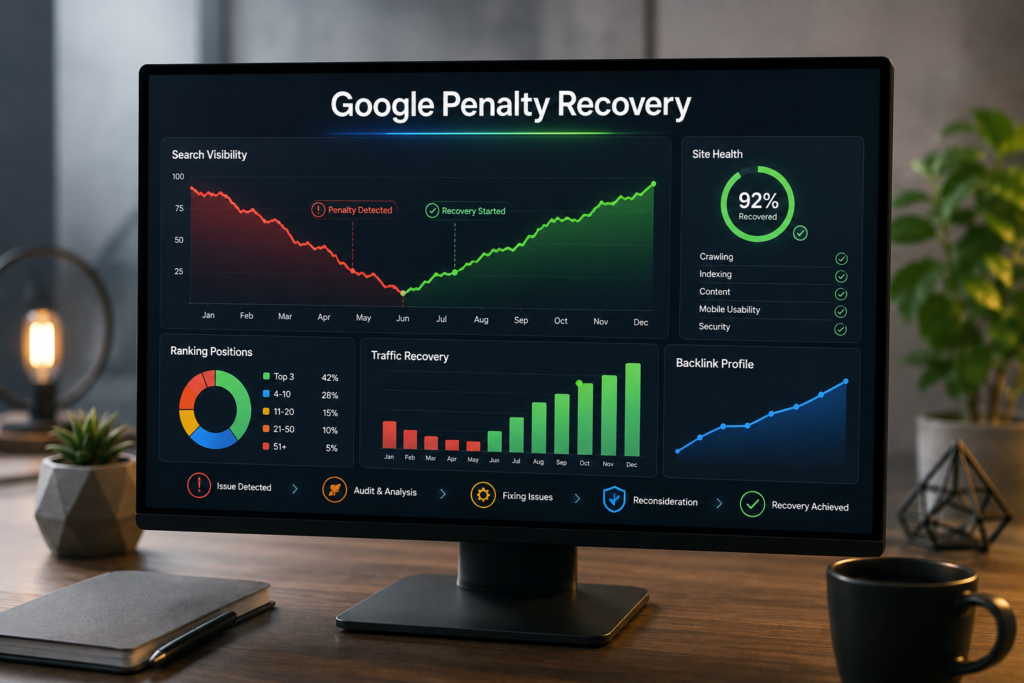
How to Start Google Penalty Recovery
The first rule of Google penalty recovery is simple: do not make random changes before identifying the cause.
Start with Google Search Console. Look specifically at the Manual Actions section to determine whether Google has identified a policy violation. If a manual action exists, read the message carefully because it provides important information about the affected area and the general type of problem.
Next, review your organic traffic and ranking history. Look for the date when visibility changed and compare it with major changes made to the website. Consider content updates, redesigns, migrations, backlink campaigns, indexing changes, redirects, or security incidents.
You should then perform a detailed website audit. Review important pages, internal links, redirects, indexation, metadata, content quality, structured data, backlinks, and technical accessibility.
Do not assume that one suspicious page is the entire problem. Google may identify patterns across a website, so recovery often requires looking beyond the pages that have visibly lost rankings.
How to Fix the Problems Behind a Penalty
Once the cause is identified, the next step is remediation.
If the issue involves unnatural links, investigate where those links came from and determine whether they were intentionally created to manipulate rankings. If you control the links, remove them where practical. For a manual action, follow Google’s specific guidance and document the steps taken.
If low-quality or spammy pages are involved, evaluate whether each page genuinely helps users. Pages that provide little value, duplicate existing material, or exist primarily to capture search traffic may need substantial improvement or removal.
For content issues, focus on originality, accuracy, usefulness, clear organization, and first-hand value. Simply rewriting sentences or adding keywords is rarely enough if the underlying page does not satisfy the user’s intent.
If your website has been hacked, remove malicious content and secure the affected systems before focusing on rankings. Likewise, if deceptive scripts, redirects, or other technical implementations are responsible for the problem, correct the implementation rather than trying to hide it from Google’s crawlers.
Google’s spam policies also make clear that attempting to circumvent its policies can lead to broader action. Fixing the underlying problem is therefore much safer than creating a new domain or repeatedly trying to bypass the system.
The Role of AI SEO in Preventing Future Problems
The growth of AI has made content production faster, but speed should not replace quality.
Using AI SEO responsibly means using automation to support research, content organization, analysis, and optimization while maintaining human oversight. Google has stated that using AI or automation to generate content with the primary purpose of manipulating search rankings violates its spam policies. At the same time, Google focuses on the quality and purpose of content rather than simply whether automation was involved.
That distinction is important.
AI can help identify content gaps, organize large datasets, analyze search intent, and generate useful starting points. But the final content should still demonstrate accuracy, originality, relevance, and genuine value for readers.
A sustainable search strategy is not about producing the largest amount of content. It is about creating resources that deserve to appear in search results.
What Is a Reconsideration Request?
A reconsideration request applies to manual actions, not ordinary ranking fluctuations.
After fixing the problems identified in a manual action, you can submit a reconsideration request through Google Search Console. Google recommends that site owners make the necessary changes before requesting reconsideration and clearly explain what was wrong and what actions were taken to correct it.
A strong request should be honest and specific. Explain the problem, describe how you investigated it, identify the changes made, and explain what measures have been introduced to prevent the issue from happening again.
Simply writing, “We fixed everything, please remove the penalty,” does not demonstrate that the underlying problem has been addressed.
It is also important not to repeatedly submit requests without making meaningful changes. Google’s guidance has emphasized that repeated violations can make successful reconsideration more difficult.
How Long Does Google Penalty Recovery Take?
There is no universal recovery timeline.
The time required depends on the severity of the problem, how extensively it affected the website, how quickly the underlying issues were corrected, and how Google’s systems process the changes.
A manual action may require a reconsideration process after remediation. An algorithmic decline may take longer to improve because the website needs to demonstrate stronger quality and relevance over time.
For businesses competing in the United States, recovery can also involve rebuilding visibility in highly competitive search results where many established websites are competing for the same queries.
The goal should not be to recover rankings as quickly as possible by making aggressive changes. The better objective is to create a website that consistently meets Google’s expectations and, more importantly, serves users well.
How to Prevent Another Google Penalty
Prevention is much easier than recovery.
Build your website around people rather than search engines. Publish useful content, avoid manipulative link schemes, keep your website technically accessible, monitor security, and regularly review pages that are generating little value.
If your business depends on geographically targeted searches, maintain accurate business information and create genuinely useful location-based content rather than producing dozens of nearly identical pages. This is particularly important for Local SEO, where low-value location pages can create more problems than opportunities.
Regularly monitor Google Search Console so unusual changes are discovered early. Keep track of new backlinks, indexation changes, important traffic patterns, and pages that suddenly disappear from search.
Most importantly, treat Google’s spam policies as a long-term quality framework rather than a checklist to work around.
Final Thoughts
A Google penalty can be serious, but a ranking drop does not automatically mean your website has been penalized. The smartest approach is to diagnose the problem before taking action.
Check for manual actions, investigate the timing of traffic and ranking changes, audit the website, identify policy violations or quality weaknesses, and fix the underlying causes. If a manual action exists, document your work and submit a clear reconsideration request only after the necessary changes have been completed.
Effective Google penalty recovery is ultimately about restoring trust, improving the quality of your website, and creating a stronger experience for users. Instead of chasing shortcuts, focus on sustainable practices that make your website genuinely useful. That approach gives your search visibility a much stronger foundation for long-term growth.