
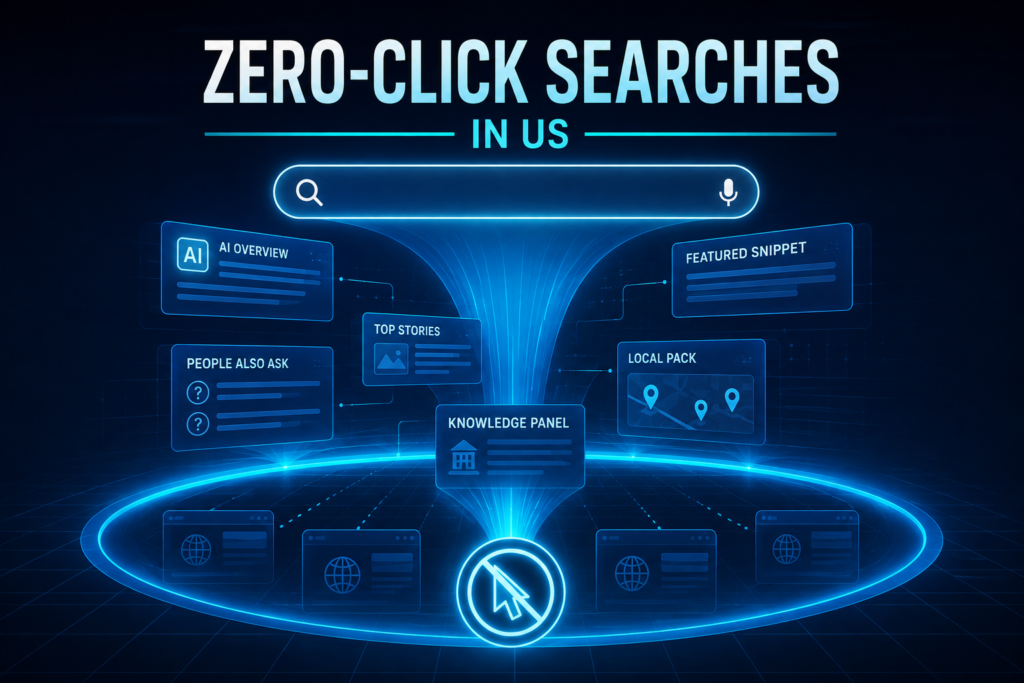
Search behavior is changing faster than many businesses realize. A customer can search for a product, compare providers, check reviews, find a nearby business, understand a service, and even make a decision without visiting a single website. This shift is creating a growing gap between search visibility and website traffic.
For businesses operating in the United States, the important question is no longer simply whether a website ranks on Google. The bigger question is whether the brand is visible when search engines and AI-powered platforms provide answers directly to users.
What Are Zero-Click Searches?
A zero-click search happens when someone enters a query into a search engine but does not click through to another website because the information they need is already displayed within the search results.
The answer might appear through a featured snippet, knowledge panel, local results, calculator, map listing, image results, related questions, or an AI-generated search response.
This does not necessarily mean users have stopped searching. It means the search journey is becoming shorter.
For example, someone might search for:
“Best dentist near me”
Instead of opening several websites, they may compare business names, ratings, locations, opening hours, and reviews directly in the search interface. The user may then call a business or visit its location without ever recording a traditional website session.
That creates an important distinction: a click is no longer the only meaningful outcome of a search.
Why Zero-Click Searches in US Are Growing
The rise of zero-click searches in US is connected to the way search engines increasingly understand intent rather than simply matching keywords with web pages.
Google can now interpret queries, connect information from multiple sources, and present useful answers directly on the results page. Search features have also expanded considerably, giving users more information before they decide whether a website visit is necessary.
AI-powered search is accelerating this behavior even further. Instead of showing users a list of ten blue links and asking them to research each result independently, AI interfaces can summarize information, compare options, answer follow-up questions, and provide sources.
Consider a query such as:
“What should I look for when choosing a home remodeling company?”
Previously, a user might click several articles and service pages. Now, a search interface can summarize the major considerations immediately.
The result is a fundamental change in the role of organic search. Websites still matter, but the search results themselves are becoming part of the customer experience.
The Difference Between Losing Traffic and Losing Visibility
A decline in website traffic does not always mean a business has become less visible.
Imagine a company appearing prominently for thousands of searches. Users may see its name, read its description, check its reviews, or encounter its content within an AI-generated answer. If those interactions do not produce a website visit, traditional analytics may interpret them as missed traffic.
This is why businesses need to separate three different outcomes:
Visibility: Was the brand presented to the searcher?
Engagement: Did the searcher interact with the brand information?
Conversion: Did the searcher call, visit, purchase, book, or contact the business?
Website sessions primarily measure the middle of this journey. They do not capture every interaction that happens before a customer reaches a website.
As search becomes more answer-oriented, businesses need a broader definition of search performance.
How Search Results Are Taking Over the Research Process
Consumers rarely make important purchasing decisions after one search. They research.
A potential customer might first search for a general problem, then investigate solutions, compare businesses, look at pricing, examine reviews, and finally search for a specific provider.
Historically, websites played a major role at nearly every stage of this process.
Now, more of that research can happen directly within search.
Search results can provide:
- Quick definitions and explanations
- Business ratings and reviews
- Locations and directions
- Product information
- Frequently asked questions
- Pricing-related information
- Comparisons and recommendations
- Images and videos
- Direct contact options
- AI-generated summaries
This changes how content needs to be created. A page should not exist merely because a keyword has search volume. It should provide information that genuinely helps a person understand a problem, evaluate an option, or take the next step.
The strongest content answers the question clearly enough to be useful while providing enough depth and credibility to encourage further engagement.
Why Rankings Alone Are No Longer Enough
A first-page ranking has traditionally been treated as one of the clearest signs of search success. But rankings do not tell the entire story anymore.
Two businesses can rank for similar queries and receive very different levels of attention.
One may appear in an AI-generated summary, local results, review features, related questions, and other search elements. Another may only appear as a standard organic listing.
Both technically have visibility, but their exposure is not equivalent.
This is particularly important for competitive markets across the United States, where businesses may compete against established brands, local companies, directories, marketplaces, publishers, and increasingly AI-generated answers.
The goal should therefore move from simply “ranking” toward being present across the search experience.
What Businesses Should Measure Instead
Businesses should begin evaluating search performance using a combination of traditional and emerging signals.
Organic impressions remain valuable because they indicate that pages are being shown to users. Rankings are still useful for understanding visibility for important queries. But these metrics should be combined with branded searches, local discovery, calls, enquiries, direction requests, conversions, and other actions.
Search Console data can help identify impressions and clicks for individual queries. Analytics can show whether website traffic is changing. Business profile data can reveal interactions such as calls and direction requests.
The key is to avoid judging search performance from website traffic alone.
A traffic decline becomes much easier to interpret when businesses can determine whether impressions are falling, clicks are falling while impressions remain stable, or customers are simply interacting differently with search results.
How Businesses Can Adapt to the New Search Journey
The response to changing search behavior should not be to abandon organic search. Instead, businesses need to make their digital presence useful beyond the traditional website click.
That means creating content around genuine customer questions rather than producing pages designed solely around keyword variations.
It also means maintaining accurate business information, developing trustworthy content, strengthening reviews, demonstrating expertise, and making important information easy for search systems to understand.
For local businesses, Local SEO becomes particularly important because customers often need practical information such as location, availability, services, reviews, and contact details before deciding to visit a website.
For broader informational searches, content should provide clear explanations, supporting evidence, useful examples, and answers to related questions.
Structured data can also help search engines interpret information about products, organizations, services, articles, events, and other entities when implemented correctly.
The objective is simple: make the brand useful wherever the customer encounters it.
AI Search Makes Brand Authority More Important
AI-driven search introduces another layer to the zero-click environment.
When an AI system generates an answer, it must determine which information and sources it considers useful and credible. A business therefore needs more than isolated pages containing relevant phrases.
Its overall digital footprint matters.
Consistent information, authoritative references, expert content, reputable mentions, reviews, strong website content, and clear business details can all contribute to how a brand is understood across digital ecosystems.
This is where AI Seo becomes relevant. The focus is not simply on optimizing content for an algorithm but on making a business understandable, trustworthy, relevant, and citable within AI-assisted search experiences.
Businesses should also remember that AI-generated answers can influence customers before they ever reach a company’s website. If a brand is consistently absent from those conversations, competitors can occupy that attention instead.
The Future of Search Is Not Clickless — It Is Different
The rise of zero-click searches in US does not mean websites are becoming irrelevant.
Websites remain essential destinations for detailed information, transactions, bookings, enquiries, purchases, and relationship building. What is changing is the path customers take to reach them.
Some users will still click immediately. Others will discover a business through a local listing, read reviews first, interact with an AI-generated response, watch a video, ask another question, and only visit the website when they are ready to act.
That means businesses should stop treating every search impression as a race for a click.
The more useful objective is to become a trusted answer throughout the customer’s decision-making journey.
What This Means for Your Search Strategy
The most important lesson from zero-click searches in US is that search visibility cannot be measured by traffic alone.
A business can receive fewer clicks while remaining highly visible. Conversely, it can receive website traffic without having strong visibility across the wider search ecosystem.
The businesses best positioned for this shift will be those that understand customer intent, answer questions thoroughly, maintain accurate information, demonstrate genuine expertise, and build authority across multiple digital touchpoints.
Traditional SEO Services can still play an important role, but the strategy needs to reflect how people actually search today.
Search is moving from a system where users primarily discover websites to one where users increasingly discover answers, businesses, products, and brands directly.
The opportunity is not to fight that change. It is to make sure your brand is part of the answer.