
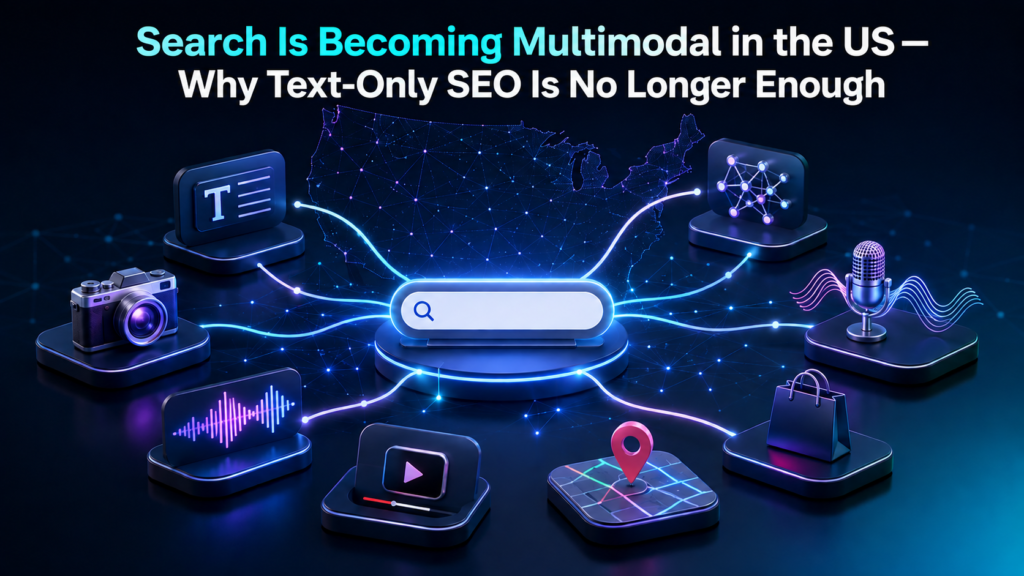
Search behavior is changing faster than traditional search strategies can keep up. People no longer rely only on typed queries to find information, products, businesses, and answers. They use images, voice, videos, screenshots, maps, visual search tools, and increasingly sophisticated AI-powered interfaces to discover what they need.
This shift is creating a major change in how brands need to think about visibility.
For years, search optimization largely revolved around written content, keywords, backlinks, metadata, and rankings for text-based queries. Those fundamentals still matter, but they are no longer the complete picture. Search engines can now understand relationships between text, images, video, location, products, entities, and user intent.
That means businesses that optimize only their written webpages may miss important opportunities to appear when potential customers search in other ways.
What Is Multimodal Search?
Multimodal search refers to search experiences that allow users to interact with a search engine through more than one type of input or information format.
A person might type a question and receive an answer containing images. Another user might upload a photograph to identify a product. Someone could speak a question rather than type it. A shopper may use an image to find visually similar products, while another person could combine a photo with a written question to obtain more specific information.
The important difference is that search engines are becoming better at interpreting different forms of information together.
Text, images, video, audio, structured data, and contextual signals can all contribute to understanding what a user wants.
This development changes the meaning of optimization. Instead of asking only, “What keyword should this page rank for?” marketers increasingly need to ask, “How can this brand become useful and discoverable across different search experiences?”
Why Text-Only Optimization Is Losing Its Advantage
Text remains one of the most important sources of information for search engines, but relying exclusively on text creates a narrow search strategy.
Imagine a customer looking for a particular type of furniture. A traditional search might involve typing “modern wooden dining table” into a search engine. But another customer may take a picture of a table they like and search for visually similar designs. Someone else might ask through voice, “Where can I find a six-seat wooden dining table near me?”
These users may have the same basic commercial intent, but they are expressing it differently.
A website focused solely on written keyword targeting may perform well for the first scenario while being poorly prepared for the others.
Multimodal search SEO addresses this broader environment by connecting textual relevance with visual assets, video content, structured information, product details, location signals, and other forms of discoverable content.
The goal is not to abandon traditional SEO. It is to expand it.
How Businesses Can Adapt Their Search Strategy
A successful multimodal strategy begins with understanding how customers actually discover information.
Written content should continue to answer important questions clearly, but pages should also contain useful visual and contextual elements. Original images, descriptive image filenames, meaningful alt text, captions, informative videos, diagrams, product visuals, and supporting media can all strengthen the usefulness of a page.
The quality of these assets matters. Simply adding dozens of generic images does not create a stronger search presence. Visual content should provide information that helps users understand a product, process, location, service, or concept.
Video deserves particular attention. A detailed article explaining how something works can be supported by a short demonstration. A product page can include a video showing the product in use. A service business can create videos answering common customer questions.
These assets create additional ways for people to discover and understand the brand.
Businesses should also pay attention to structured data. Search engines need clear signals to interpret what a webpage represents. Information about products, organizations, locations, reviews, events, articles, and other entities can help search systems understand content more effectively when implemented appropriately.
The Growing Role of AI in Search Discovery
AI is accelerating the transition from traditional keyword matching toward deeper interpretation of user intent.
Modern search systems can connect concepts even when the exact wording of a query does not appear on a webpage. This makes topical depth increasingly important.
For example, a page about residential solar panels should not depend entirely on repeatedly mentioning one target phrase. A genuinely useful resource might explain installation, maintenance, energy production, costs, warranties, equipment types, regulations, and common customer concerns.
AI-driven search systems can use these relationships to determine whether the content provides comprehensive value.
This also means AI SEO should not be treated as simply producing large quantities of automatically generated articles. Sustainable optimization requires accurate information, original insights, clear organization, trustworthy sources, and content created around real user needs.
The strongest strategy is to use AI as part of a broader research, analysis, and content workflow while maintaining human judgment and editorial quality.
Visual Content Is Becoming Part of Search Visibility
Images are no longer just decorative elements placed beside written content.
For many industries, visual information can communicate something faster than several paragraphs of text. Fashion, home improvement, food, travel, architecture, automotive, retail, beauty, manufacturing, and many other sectors can benefit from visual discovery.
A strong visual optimization strategy starts with relevance. Images should accurately represent the subject of the page and should be useful to the person viewing them.
Technical details matter as well. Descriptive filenames, appropriate dimensions, efficient formats, responsive implementation, useful alt text, and surrounding contextual content can make visual assets easier to understand and access.
Original photography can also provide an advantage over generic stock imagery. A real business location, original product photograph, demonstration, before-and-after example, or proprietary diagram can provide information that cannot be replicated easily by competitors.
The same principle applies to video. Instead of treating video as a separate marketing channel, businesses can integrate it into their broader content ecosystem.
Why Local and Regional Context Matter
Search becomes particularly interesting when visual and conversational discovery intersects with geography.
Someone might search for a restaurant by uploading a picture of a dish. Another person may ask a voice assistant for a nearby service provider. A traveler might use an image to identify a landmark and then search for attractions around it.
These behaviors demonstrate why geographic relevance should be connected with useful content rather than treated as a separate technical exercise.
For businesses targeting customers across the United States, search strategies should reflect differences in language, regional preferences, locations, services, and customer intent rather than assuming that one generic page will satisfy every audience.
For businesses serving specific communities, Local SEO can help reinforce location-based relevance through accurate business information, useful local content, reviews, and consistent signals across relevant platforms.
The broader lesson is simple: search engines increasingly interpret context, and location is an important part of that context.
What SEO Teams Should Measure Beyond Rankings
Traditional rankings remain useful, but they do not tell the entire story in a multimodal search environment.
Businesses should examine how users interact with different types of content. Image visibility, video engagement, organic traffic by landing page, branded searches, conversions, engagement patterns, and discovery through local or product-oriented experiences can reveal opportunities that a simple keyword-ranking report may overlook.
It is also important to examine the questions customers are asking.
Search queries can reveal whether people want comparisons, instructions, pricing information, product recommendations, visual examples, local options, or explanations. Those insights can guide the creation of text, images, videos, FAQs, and other content formats.
For organizations working with SEO Services, this broader measurement approach can make reporting more meaningful. Instead of focusing exclusively on whether a page moved from position eight to position five, teams can evaluate whether the content is reaching more relevant users and helping them take meaningful actions.
Building a Future-Ready Search Strategy
The move toward multimodal search does not mean that conventional SEO is becoming irrelevant. It means the definition of search visibility is expanding.
A strong strategy should connect several elements: technically accessible webpages, valuable written content, original visual assets, useful video, structured information, strong internal linking, credible references, and clear signals about products, services, organizations, and locations.
Content should also be designed around questions rather than isolated keywords.
When someone searches for a product, they may want to know what it looks like, how it works, whether it fits their needs, where it is available, how much it costs, and what alternatives exist. A page capable of answering those questions through multiple formats is more useful than a page created simply to satisfy a keyword target.
This is where multimodal search SEO becomes a strategic mindset rather than a single optimization technique.
Businesses that start organizing their content around complete user journeys will be better prepared as search interfaces continue to evolve.
The Future of Search Belongs to Multiple Formats
Search is becoming less like a simple box where people enter keywords and more like an intelligent discovery environment.
Users can ask questions, show images, speak naturally, watch demonstrations, explore maps, compare products, and combine different types of information. Search systems are becoming capable of connecting these signals to understand intent more effectively.
For marketers, the response should not be to chase every new feature individually. Instead, the focus should be on building genuinely useful information in formats that match how people prefer to discover and consume it.
Text remains essential. But text should increasingly work together with images, video, structured information, location signals, and other forms of content.
Brands that make this transition can create more ways for customers to find them, understand what they offer, and ultimately choose them. The opportunity is not simply to rank for more searches. It is to become discoverable wherever and however the next generation of search users chooses to look.