
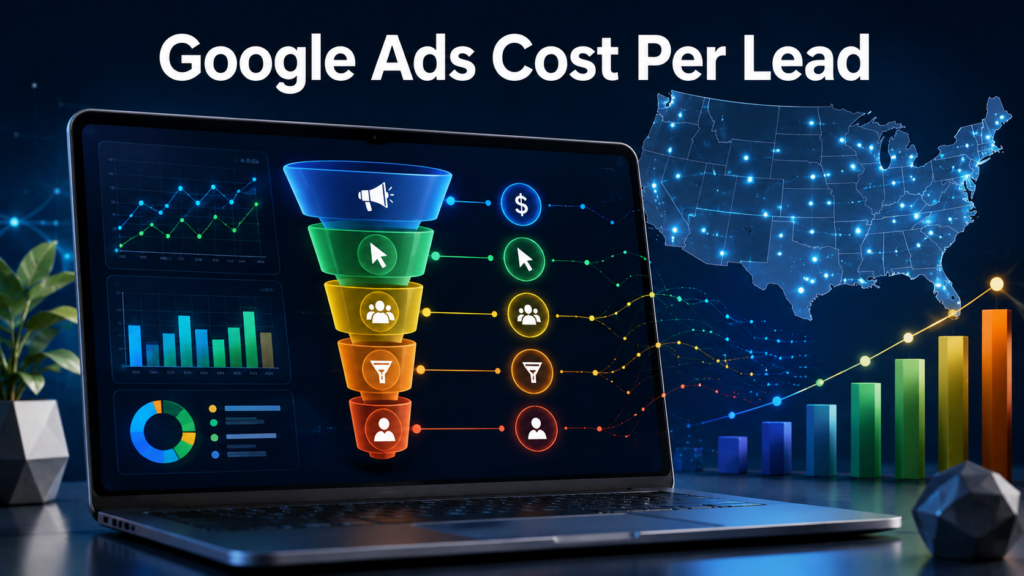
Google Ads can generate leads quickly, but getting traffic is only half the equation. The more important question for most businesses is whether those clicks are producing leads at a cost that makes financial sense.
A campaign can have thousands of impressions, a strong click-through rate, and plenty of website visitors while still being unprofitable if each lead costs too much. On the other hand, a higher lead cost is not necessarily bad when those leads are highly qualified and regularly turn into valuable customers.
So, what should businesses actually consider a good Google Ads cost per lead in the US? There is no universal number. A reasonable CPL depends on the industry, customer value, competition, location, conversion rate, and how effectively leads are handled after they arrive.
This guide explains how to evaluate CPL, what influences it, and how businesses can determine whether their campaigns are genuinely performing well.
What Does Cost Per Lead Mean in Google Ads?
Cost per lead, commonly called CPL, is the average amount spent on advertising to generate one lead.
The basic calculation is:
Cost Per Lead = Total Google Ads Spend ÷ Number of Leads Generated
For example, if a company spends $5,000 on Google Ads and receives 100 qualified leads, its average CPL is $50.
However, this simple calculation does not tell the whole story. Two companies could both have a $50 CPL but achieve completely different results.
Company A might generate leads that rarely purchase, while Company B could turn a significant percentage of those leads into customers. In that situation, Company B may have a much stronger advertising campaign even though both businesses have the same CPL.
That is why CPL should be viewed alongside lead quality, sales conversion rate, customer acquisition cost, and customer lifetime value.
What Is a Good Google Ads Cost Per Lead?
A good Google Ads cost per lead is one that allows your business to acquire customers profitably.
Across the US, lead-generation costs can vary dramatically. A local service business may consider a CPL of $30–$100 acceptable, while legal, financial, medical, B2B, or high-ticket services may comfortably support CPLs of $100–$500 or considerably more.
For some highly competitive markets, even a CPL above $500 can make economic sense when a single new customer is worth several thousand dollars.
Rather than chasing an industry-wide “perfect” CPL, businesses should establish their own target using unit economics.
Suppose your average customer generates $3,000 in gross profit and your sales team closes 20% of qualified leads. If you generate one customer from every five leads, a $200 CPL means approximately $1,000 in advertising cost per customer. That could be highly sustainable.
In contrast, a $50 CPL might look attractive but become expensive if almost none of those leads become customers.
How Industry, Competition, and SEO Services Affect CPL
The industry you operate in has a major influence on advertising costs. Keywords connected to emergency services, attorneys, insurance, real estate, software, and other valuable customer transactions often attract aggressive competition. When several advertisers compete for the same searches, CPCs can rise, increasing the potential cost of each conversion.
Geography matters as well. Advertising in major metropolitan markets can be more expensive than targeting smaller locations because advertisers are competing for a larger pool of commercially valuable searches.
Landing-page quality is another important factor. A relevant page with a clear offer, persuasive information, fast loading speed, and an easy-to-use form can convert more visitors into leads. Improving conversion rates means you can generate more leads without increasing ad spend.
Organic visibility also has an indirect role. Strong SEO Services can help businesses capture demand outside paid search, potentially reducing dependence on advertising for some searches over time. Paid and organic strategies should not necessarily be treated as competitors; they can work together to cover different stages of the search journey.
Why Lead Quality Matters More Than a Low CPL
One of the most common Google Ads mistakes is optimizing exclusively for cheap leads.
Imagine an account generating leads for $25 each. That sounds excellent until the business discovers that many inquiries are outside its service area, have no purchasing intent, or are simply looking for free information.
Now consider another campaign producing leads at $120 each. If those prospects have strong buying intent and 30% become customers, the second campaign may be far more profitable.
This is why businesses should distinguish between a lead and a qualified lead.
A useful measurement system tracks what happens after the form submission or phone call. Important metrics include qualified-lead rate, appointment rate, sales conversion rate, revenue per customer, and customer acquisition cost.
Google Ads should ultimately be judged by business outcomes rather than clicks alone.
How AI SEO and Conversion Optimization Can Reduce Advertising Pressure
Paid search performance does not exist in isolation. Businesses can strengthen their overall search presence by combining advertising with useful organic content and conversion-focused website improvements.
AI SEO can support the content research and optimization process by helping identify search themes, content gaps, related questions, and opportunities for creating useful resources. However, automated content alone does not guarantee rankings or qualified traffic. Content still needs accurate information, genuine expertise, clear structure, and value for the reader.
Conversion optimization is equally important. If 1,000 visitors reach a landing page and only 20 become leads, improving the conversion rate can dramatically change the economics of the campaign.
For example, increasing the conversion rate from 2% to 4% can potentially double the number of leads generated from the same traffic. If ad spending remains unchanged, the effective cost per lead can fall substantially.
This is often more productive than simply trying to find cheaper clicks.
What Factors Increase Google Ads CPL?
Several variables can push lead costs higher.
Keyword competition is one of the biggest factors. Commercial keywords with strong purchasing intent are often expensive because multiple companies are willing to pay for those searches.
Match between keyword and landing page also matters. Someone searching for a specific service should arrive on a page directly related to that service rather than a generic homepage.
Ad relevance can influence campaign efficiency. Clear messaging that closely matches the searcher’s intent can improve engagement and help the campaign attract more appropriate visitors.
Geographic targeting can change performance considerably. A national campaign may produce a very different CPL from a campaign focused on a handful of cities.
Conversion tracking is another critical factor. If forms, calls, chats, or booked appointments are not tracked correctly, reported CPL can be misleading. Businesses may either overestimate or underestimate campaign performance.
Finally, sales follow-up can affect the economics of advertising. A high-quality lead that receives a slow response may be lost even though the advertising campaign performed correctly.
How to Calculate Your Ideal CPL
Instead of copying a benchmark from another business, calculate the maximum amount you can afford to spend to acquire a customer.
Start with the average revenue or gross profit generated by a new customer. Then determine what percentage of qualified leads typically become customers.
For instance, if your business earns $2,000 in gross profit per customer and closes 25% of qualified leads, each customer requires approximately four qualified leads.
If you decide that advertising can consume up to $600 of that gross profit, your target CPL would be around $150.
The calculation becomes more useful when based on actual campaign data. As the account accumulates conversions, you can compare different campaigns, keywords, locations, devices, and landing pages.
Your target should also allow room for operational costs and fluctuations. A campaign that is profitable only under perfect conditions may not be sustainable.
When a High CPL Is Actually a Good Result
A high CPL should not automatically trigger concern.
High-ticket businesses often have greater customer values, making higher acquisition costs reasonable. Consider a company selling a $10,000 service with strong margins. Paying $300 for a qualified lead could be entirely sensible if enough leads convert into customers.
The key question is:
How much profit does each lead ultimately produce?
This shifts the conversation from “How can we get cheaper leads?” to “How can we acquire more valuable customers efficiently?”
That distinction can completely change campaign strategy. A business might intentionally accept a higher CPL for keywords that consistently produce better customers while reducing spending on inexpensive sources that generate weak inquiries.
How Local SEO Can Complement Paid Lead Generation
For companies serving specific communities, Local SEO can strengthen visibility for location-based searches while paid campaigns provide additional exposure.
This can be particularly useful for service businesses where customers frequently search with geographic intent. Someone looking for a nearby provider may interact with paid advertisements, organic listings, maps results, reviews, or the company’s website before making a decision.
A strong local presence can also improve credibility. When prospects repeatedly encounter the same business across different search experiences, the brand may become more familiar and trustworthy.
The goal is not simply to replace paid advertising with organic search. Instead, businesses can use multiple channels to capture demand and reduce their reliance on any single source of leads.
How to Improve Your Google Ads Cost Per Lead
Improving CPL usually requires several small optimizations rather than one dramatic change.
Begin by examining which campaigns and search terms produce qualified customers rather than simply counting conversions. Remove or restrict traffic that consistently generates poor-quality inquiries.
Next, test landing pages. Different headlines, offers, calls to action, forms, layouts, and trust elements can produce meaningful differences in conversion rates.
Review geographic performance as well. If certain locations produce expensive leads with weak sales results, budgets can potentially be shifted toward stronger areas.
Ad copy should also be tested regularly. Clear qualification messaging can sometimes reduce total lead volume while improving lead quality.
Most importantly, connect advertising data with sales data whenever possible. Knowing which campaigns generate revenue gives you a much stronger basis for budget decisions than platform conversions alone.
Final Thoughts
There is no single CPL that defines a successful Google Ads campaign in the United States. A $50 lead may be expensive for one business and exceptionally profitable for another.
The right benchmark depends on customer value, margins, close rates, competition, location, and lead quality. Businesses should therefore establish a target based on their own economics and continuously compare advertising costs with actual sales results.
The best campaigns are not necessarily those with the cheapest leads. They are the campaigns that consistently turn advertising investment into profitable customers.
If you monitor the complete journey—from search query and click to lead, qualified opportunity, sale, and revenue—you can make much smarter decisions about how much a lead is really worth and where your advertising budget should go.