
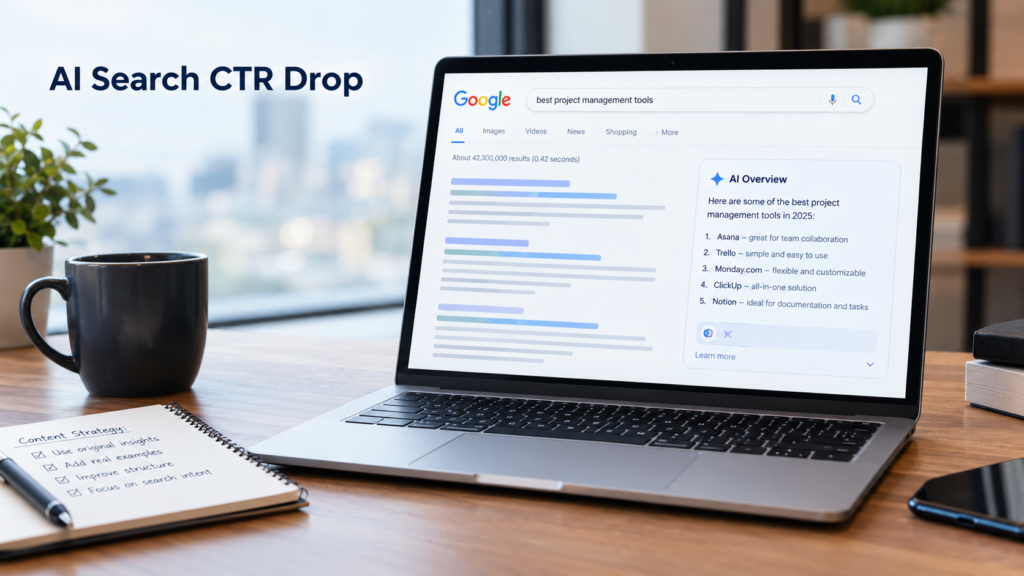
A page can maintain strong rankings, impressions, and useful content while receiving significantly fewer clicks than it did before. This is becoming an important problem for informational publishers as search results increasingly answer questions before users reach a website.
The concern is not simply that organic traffic is declining. The bigger issue is where the click is going.
Searchers can now encounter summaries, answer boxes, AI-generated responses, discussions, videos, maps, product information, and other SERP features without visiting a traditional webpage. As a result, a position that once generated substantial traffic may no longer produce the same number of visits.
This shift is creating what many publishers describe as an AI search CTR drop. But the causes are more complicated than AI alone.
Why Are Informational Blogs Losing Clicks?
Informational searches have historically been one of the strongest sources of organic traffic. Someone searches for an explanation, comparison, definition, process, or solution, and Google provides a list of pages that can answer the question.
The user then chooses a result and visits the website.
That journey is changing.
Search engines increasingly attempt to satisfy the initial information need directly within the search experience. A person searching for a question may receive a summary before deciding whether a website is worth visiting.
This creates a separation between visibility and website traffic.
A page can appear frequently in search results but receive fewer clicks because the searcher has already received enough information to make a decision. This is particularly important for content targeting broad informational queries where the answer can be understood without additional research.
The result is that traditional click-through-rate benchmarks may become less reliable for evaluating content performance.
What Does a 40–60% CTR Decline Actually Mean?
A 40–60% decline should not automatically be interpreted as a universal industry-wide benchmark. CTR varies considerably by query type, ranking position, device, brand recognition, SERP layout, search intent, and the presence of competing features.
However, a substantial decline in clicks can happen even when impressions remain stable.
Consider a simplified example.
A blog receives 100,000 monthly impressions and historically earns a 5% CTR. That produces approximately 5,000 visits.
If the same page continues receiving 100,000 impressions but its CTR falls to 2.5%, traffic drops to roughly 2,500 visits.
The ranking did not necessarily disappear. The impressions did not necessarily disappear either.
The search journey changed.
This distinction matters because fixing a traffic decline requires understanding whether the problem is ranking loss, demand loss, or reduced willingness to click.
If rankings have remained relatively stable but clicks have fallen, publishing more articles blindly may not solve the problem.
How Search Results Are Changing User Behaviour
Search behaviour is becoming more selective.
Users increasingly scan a results page before deciding whether a website deserves their attention. If the search engine provides a useful answer immediately, the motivation to open several results decreases.
This does not mean websites have become irrelevant. It means the reason for clicking has changed.
A page now needs to offer something beyond the basic answer already visible in search.
That could be deeper evidence, original research, practical examples, proprietary data, expert interpretation, detailed comparisons, tools, first-hand experience, or information that cannot easily be compressed into a short summary.
For publishers, this creates an important strategic question:
Why would someone still click your result after seeing the search preview?
If the answer is unclear, the page may be vulnerable to declining CTR.
The Real Problem May Be Search Intent
Not every traffic decline is caused by AI-generated search experiences.
Search intent can change over time.
A query that once indicated strong research intent may gradually become a quick-answer query. Users may also change the language they use, search from different devices, or expect different types of content.
For example, someone searching for a simple factual question may have previously opened three or four articles. Today, that same person may only need a short answer.
Meanwhile, complex commercial research often still requires multiple sources.
This is why publishers should evaluate CTR at the query level, rather than assuming that an entire website is experiencing the same problem.
Look at:
- Impressions before and after the decline
- Average ranking position
- CTR by query
- CTR by device
- Branded versus non-branded searches
- Search intent
- SERP features appearing for important queries
- Landing-page engagement
- Changes in search demand
These signals can reveal whether the problem is visibility, competition, intent, or reduced clicks from the search results themselves.
What Role Does SEO Services Strategy Play?
A modern content strategy needs to move beyond publishing articles around keywords.
SEO Services can support a broader evaluation of technical performance, search intent, content structure, internal linking, authority, and SERP competition. The objective is not simply to make a page rank. It is to understand what makes that page valuable enough to earn the click.
One useful approach is to separate informational content into three categories:
Answer content provides a direct response to a simple question.
Research content helps users understand a subject in greater depth.
Decision content helps users compare options or determine what to do next.
Answer-focused pages may face stronger click pressure because search engines can satisfy those queries quickly. Research and decision-oriented content can have greater opportunities to attract visits when they provide meaningful depth that cannot be easily summarized.
This does not mean every blog needs to become extremely long. Depth should be determined by the complexity of the user’s question, not by an arbitrary word count.
How Can You Make Informational Content Worth the Click?
The strongest response to declining CTR is not clickbait.
It is greater information value.
Start by identifying what the search results already answer. Then determine what your page can provide that is missing, unclear, outdated, or poorly explained elsewhere.
Originality becomes especially important here.
Instead of repeating commonly available information, consider adding original examples, calculations, expert commentary, process explanations, industry observations, first-party data, case evidence, or clearly explained conclusions.
Your introduction also matters.
If the first few lines simply repeat the question and provide a generic answer, users have little reason to continue. A stronger introduction establishes the problem quickly and shows what the reader will understand by staying on the page.
The structure should also make deeper information easy to discover. Clear headings, concise explanations, supporting evidence, relevant examples, and logical progression can increase the likelihood that visitors continue reading.
Why Local Search Faces a Different CTR Challenge
Local search has its own version of the zero-click problem because search engines can display business information directly in the results.
Users may see locations, opening hours, reviews, phone numbers, directions, photos, and other business details without visiting a website.
That makes local seo fundamentally different from traditional informational publishing.
For local businesses, website clicks are only one part of the search journey. A search may generate a phone call, direction request, booking, or store visit instead.
Therefore, businesses should avoid judging search performance solely through website sessions. Search visibility can influence actions that never appear as a website visit.
The same principle applies to informational content: a click is valuable, but it is not the only signal of search success.
What Should Publishers Measure Instead of CTR Alone?
CTR remains important, but it should be placed inside a wider performance framework.
Start with impressions and rankings to determine whether visibility has changed. Then examine clicks to identify whether users are becoming less likely to visit.
After that, evaluate what happens once users arrive.
A page receiving fewer clicks but attracting highly engaged visitors may be more valuable than a page receiving large volumes of low-intent traffic.
Track metrics such as engaged sessions, conversions, assisted conversions, returning visitors, scroll behaviour, and the performance of individual landing pages where appropriate.
Also compare performance across different query groups.
If informational queries are losing clicks while commercial queries remain stable, the problem may be concentrated in a particular type of search behaviour rather than affecting the entire website.
This level of analysis can prevent publishers from making unnecessary changes to content that is still performing effectively.
Is Your Blog Actually Losing Value—or Just Losing Clicks?
This is one of the most important questions to ask.
A decline in organic visits does not automatically mean that content has become weaker.
The search environment itself may have changed.
A blog can remain accurate, useful, well researched, and authoritative while receiving fewer visits because users can obtain part of its information without clicking.
That means the future of content cannot depend entirely on traffic volume.
Publishers need to build content that serves multiple purposes: answering simple questions clearly, supporting deeper research, demonstrating expertise, and creating reasons for users to explore further.
For businesses in the United States, this is particularly important because competitive search results increasingly combine traditional organic listings with richer search experiences.
How AI Search Changes the Content Strategy
An AI search CTR drop should not lead businesses to abandon informational content.
Instead, it should encourage a shift from producing content purely to capture clicks toward producing content that earns recognition, trust, and continued engagement.
AI-driven search experiences still need reliable information. Websites that consistently demonstrate expertise, provide useful evidence, explain subjects clearly, and maintain strong topical coverage can remain valuable sources within the wider search ecosystem.
The goal is therefore not to fight the changing search interface.
It is to create content that remains useful even when the search engine can summarize the basic answer.
That means asking better questions before publishing:
What does the user already know?
What information can the search result provide without a click?
What does the user need after receiving that initial answer?
What original value does this page contribute?
And most importantly:
What would make the user want to learn more from this source?
The Next Stage of Organic Search Is About More Than Rankings
CTR decline is becoming an important warning sign for informational publishers, but it should not be treated as proof that organic search is disappearing.
Search is evolving from a list of links into a more interactive information environment.
That changes the economics of publishing.
Ranking well still matters, but ranking alone may no longer guarantee the traffic it once produced. Content needs to earn attention after visibility has already been achieved.
The businesses most prepared for this shift will be those that monitor query-level behaviour, understand changing search intent, improve the information value of their pages, and measure outcomes beyond clicks.
An AI search CTR drop may look like a traffic problem on the surface. In many cases, it is actually a signal that the search journey has changed.
The answer is not to publish more content simply because traffic is falling.
The better response is to understand why people are no longer clicking—and give them a stronger reason to do so.