
The Old Voice Search Playbook No Longer Works
For years, businesses in the United States followed a simple voice search strategy: target conversational keywords, add FAQ pages, optimize for featured snippets, and expect voice assistants to read website content aloud. That approach worked when search engines relied on traditional ranking systems.
But search has changed dramatically.
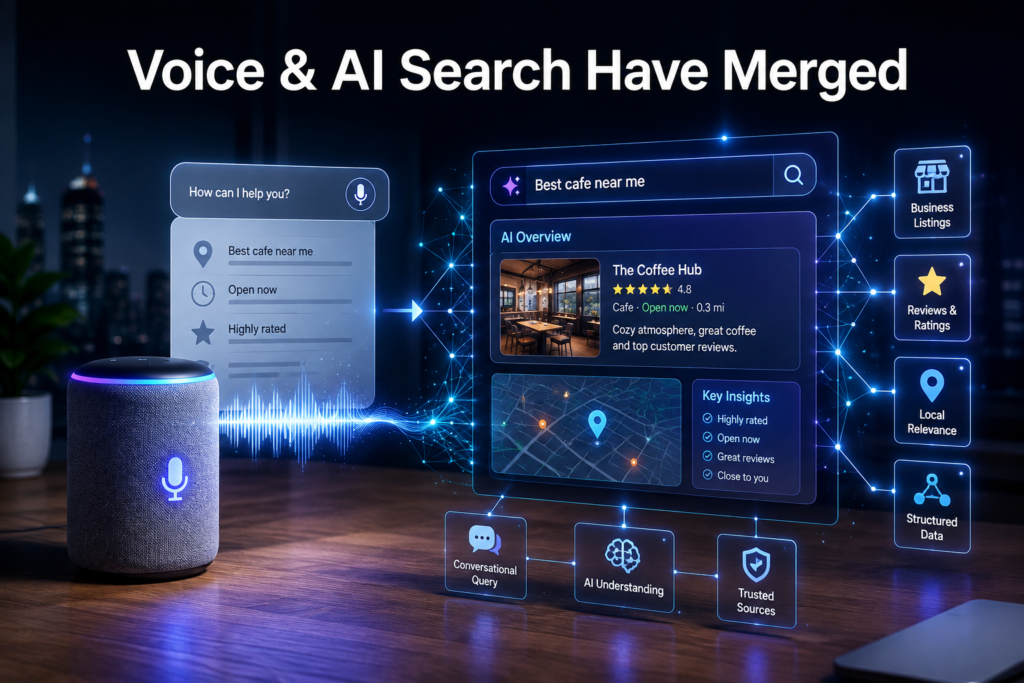
Today, voice assistants are powered by advanced AI models that generate answers by combining information from multiple sources rather than simply reading one webpage. Google’s AI-powered search experiences, conversational assistants, and generative tools have transformed how people discover businesses online. Voice queries, typed prompts, and AI conversations now follow the same path: users ask natural questions, and AI delivers synthesized answers.
This shift means businesses investing in outdated voice tactics without adapting to AI-driven search behavior are wasting valuable marketing budgets.
The future belongs to brands that understand one simple reality: voice search and AI search are no longer separate strategies.
Why Voice Search and AI Search Have Become One Ecosystem
A few years ago, voice search followed a straightforward process:
- A user asked a question.
- A search engine ranked web pages.
- The assistant read one result aloud.
Today, AI systems work differently. They analyze multiple sources, understand context, evaluate trust signals, and generate personalized answers.
Whether someone asks:
- “Best accountant near me”
- “Who offers emergency plumbing services?”
- “Which marketing agency is recommended for small businesses?”
AI systems create responses using business profiles, reviews, website content, local citations, expert mentions, and structured information. Traditional ranking alone is no longer enough.
Businesses still treating voice search as a separate SEO tactic are optimizing for a system that no longer exists.
This is why voice search optimization in US businesses must evolve from keyword-focused strategies to answer-focused content, entity authority, and AI visibility.
Why Traditional Voice SEO Is Wasting Marketing Budgets
Many businesses continue spending money on outdated tactics that produce limited results.
These include:
- Creating FAQ pages without real user intent research
- Focusing only on featured snippets
- Building content around exact-match voice keywords
- Ignoring AI-generated answers
- Treating search, content, and brand reputation as separate efforts
The problem is that AI systems evaluate much more than webpage rankings. They look for expertise, consistency, trust, local signals, and strong digital footprints.
Businesses investing in outdated methods often miss opportunities where customers now make decisions: inside AI-generated answers.
This is where modern SEO services are changing. The goal is no longer just improving rankings. The goal is becoming a trusted source that AI platforms choose to reference.
Research also shows that search behavior in the United States is becoming more conversational, with longer queries, planning-based searches, and growing use of voice and AI interactions.
The Rise of AI-Powered Local Discovery
Local search is one of the biggest areas where change is happening.
Consumers increasingly ask questions like:
- “Best dentist near me”
- “Top-rated coffee shop nearby”
- “Emergency electrician open now”
AI systems do not simply pull a list of websites. They evaluate business information, reviews, reputation, local relevance, and user satisfaction before presenting recommendations.
This is why strong Local SEO practices remain essential, but they now need to support AI systems as well as traditional search engines.
Businesses that maintain accurate business information, earn genuine reviews, publish expert content, and strengthen their online presence are more likely to appear in both local results and AI-generated recommendations.
For companies operating across the United States, this creates a significant opportunity. Brands that establish strong digital authority today can become the preferred sources AI systems use tomorrow.
The New Strategy for AI and Voice Visibility
Businesses no longer need separate strategies for voice search and AI search.
Instead, they need a unified approach built around trust, clarity, and authority.
Modern optimization should include:
Build Content Around Real Questions
People no longer search using short keywords. They ask complete questions.
Create content that answers:
- How
- Why
- When
- Which
- Best options
- Comparisons
This improves visibility across both search engines and AI systems.
Strengthen Entity Signals
AI platforms understand brands as entities, not just websites.
Maintain consistent information across:
- Website content
- Business listings
- Review platforms
- Industry directories
- Social profiles
Use Structured Data
Schema helps AI understand:
- Services
- Locations
- Reviews
- FAQs
- Organizations
Clear data improves machine understanding.
Demonstrate Expertise
AI systems increasingly prioritize trustworthy sources.
Expert insights, case studies, original research, and real-world experience help establish authority.
This is where AI SEO is becoming an essential part of digital strategy. Businesses are no longer optimizing only for search engines; they are optimizing for AI systems that influence customer decisions.
Why Businesses Must Measure Visibility Differently
Traditional SEO metrics focused on:
- Rankings
- Clicks
- Website traffic
AI search introduces new measurements:
- Brand mentions
- AI citations
- Recommendation frequency
- Local visibility
- Trust signals
A business might receive fewer clicks while gaining more exposure inside AI-generated answers.
This changes how marketing success should be evaluated.
Companies that continue measuring only rankings may miss the bigger opportunity: becoming the trusted source AI recommends.
The Future of Search Is Conversational
Search is no longer limited to typing keywords into a search box.
People speak naturally, ask complex questions, compare options, and seek instant answers. AI systems respond by combining information from multiple trusted sources rather than showing a simple list of links.
This means businesses still following old voice SEO checklists risk spending budget on tactics designed for yesterday’s search environment.
The smarter approach is simple:
Optimize for answers, not just rankings.
Build authority, not just pages.
Create trust, not just traffic.
Businesses that adapt to this shift will not only improve voice search optimization in US markets but also strengthen their visibility across AI assistants, conversational search, and the future of digital discovery.
The companies that understand this change today will become the brands AI recommends tomorrow.