
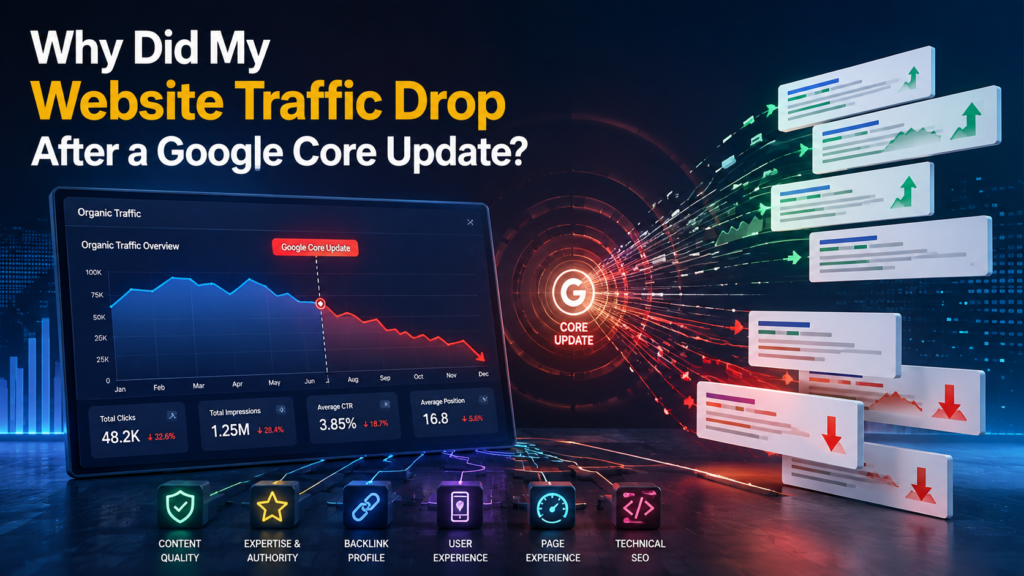
A sudden decline in website traffic after a Google core update can leave you wondering whether something went seriously wrong with your website. One week your pages may be generating consistent impressions, clicks, leads, and sales. Then a broad Google algorithm update rolls out, and organic traffic begins to fall.
The first reaction is often to assume that Google has penalized the website. In many cases, that is not what happened.
Google core updates are broad changes to its ranking systems. They can change how Google’s systems understand relevance, content quality, usefulness, authority, search intent, and the overall satisfaction a page provides. Because search rankings are relative, your website can lose positions even when you have not made a technical mistake.
If your website traffic dropped after Google core update, the most important thing is to understand why the decline happened before making major changes. A careful investigation can reveal whether the problem involves content quality, changing search intent, stronger competitors, outdated information, technical issues, declining search demand, or changes in the search results themselves.
What Is a Google Core Update?
A Google core update is a significant change to Google’s core ranking systems. These systems contain many signals and automated processes that help Google determine which pages should appear for different searches.
Google continuously improves these systems because the web changes constantly. New websites appear, existing websites publish better information, users change how they search, and entire industries evolve.
A core update can therefore change the way Google evaluates pages without targeting a particular website.
Imagine that Google previously considered ten pages to be strong answers for a particular search. After improving its systems, it may determine that three of those pages provide substantially better answers than the others. Those three pages may gain visibility while the remaining pages move down.
That does not necessarily mean the pages that lost rankings were suddenly “bad.”
It means their relative usefulness and relevance may now be evaluated differently.
This distinction is important because it changes how you should respond. If you treat a core update as a penalty, you may spend weeks searching for something that does not exist.
Instead, you should investigate what changed in the relationship between your content, your audience, and the pages Google now considers stronger.
Why Did My Website Traffic Drop After a Google Core Update?
There is rarely one universal reason for an organic traffic decline.
Search intent may have changed
One of the most important areas to investigate is search intent.
Search intent is the underlying reason someone performs a search. A person searching for “best CRM for small business” probably wants comparisons, recommendations, features, pricing, and practical considerations. Someone searching for “what is CRM” probably needs a definition and explanation.
Search engines continually become better at identifying these differences.
Suppose your article historically ranked for a keyword because it contained a general explanation. After an algorithm improvement, Google may determine that users are better served by detailed comparison pages, practical guides, original research, or product-focused resources.
Your page may then lose visibility even though its information is still technically accurate.
This is why looking only at keywords is not enough.
When a page loses rankings, examine the current search results. Look at the pages replacing it. Ask what those pages provide that yours does not.
The answer could be better examples, clearer explanations, newer information, stronger evidence, more practical detail, or simply a better match for the searcher’s actual goal.
Competitors may have become stronger
Google rankings are competitive.
Your website does not exist in isolation. If five competitors significantly improve their content while your page remains unchanged, your relative position can decline.
Competitors may improve through original research, expert contributions, better examples, updated statistics, stronger internal linking, clearer page structures, better media, or more comprehensive coverage of the topic.
This creates an important distinction:
A ranking decline does not always mean your website became worse. It can mean another website became better.
That is why competitor analysis should be part of every serious core-update investigation.
Do not simply compare word counts. A 2,000-word article is not automatically better than a 1,000-word article.
Instead, compare:
- How directly each page answers the query
- Whether the information is current
- The depth of useful explanations
- Original insights and evidence
- First-hand experience
- Topic coverage
- Content organization
- Clarity and readability
- Trust signals
- Internal and external references
- Overall usefulness to the reader
The objective is to understand why users and Google’s systems may prefer the competing page.
Outdated Content Can Become a Ranking Problem
Content can lose effectiveness without becoming technically incorrect.
Consider an article about digital marketing statistics published several years ago. The basic principles may remain valid, but the statistics, platforms, user behavior, technology, and competitive environment may have changed dramatically.
A page can therefore become outdated in subtle ways.
Review your content for outdated statistics, old screenshots, discontinued products, obsolete recommendations, expired examples, incorrect terminology, broken references, and conclusions based on information that is no longer representative.
However, updating a page does not mean changing its publication date and replacing a few numbers.
A meaningful update should reconsider whether the entire page still solves the user’s problem.
Sometimes an article needs a few corrections. Sometimes the structure needs to be rebuilt. In other cases, the original topic has changed so much that a new resource is more appropriate.
Thin Content Is More Than Short Content
Many website owners believe that thin content simply means an article with too few words.
That is not necessarily true.
A long article can still be thin if it contains repetitive statements, generic explanations, unnecessary introductions, or information that does not help the reader accomplish anything.
Conversely, a shorter page can be extremely useful if it answers a specific question accurately and efficiently.
Google’s systems are designed to surface useful information, not pages that reach a particular word count.
Ask yourself whether every major section contributes something meaningful.
Does the page answer the primary question?
Does it address important follow-up questions?
Does it explain difficult concepts clearly?
Does it provide evidence where evidence matters?
Does it include practical information that readers can actually use?
Does it demonstrate knowledge that cannot easily be found by copying several competing pages?
These questions are far more valuable than simply adding another 500 words.
How to Diagnose a Core Update Traffic Drop
Before changing content, establish exactly where the decline occurred.
Google Search Console is one of the most useful starting points because it allows you to compare search performance before and after a change.
Start by comparing a meaningful period before the update with the period after the update. Examine total clicks and impressions, but do not stop there.
The deeper investigation should happen at the page and query levels.
For example, imagine organic traffic declined by 30%. That number alone does not tell you much.
You may discover that:
- One major page lost 80% of its clicks.
- Several smaller pages gained traffic.
- Branded searches remained stable.
- Non-branded searches declined significantly.
- Mobile rankings changed more than desktop rankings.
- One particular topic category experienced most of the losses.
That tells a very different story from a website where every page lost visibility.
Analyze pages individually
Identify your biggest traffic-loss pages and compare their performance before and after the update.
Look at:
Clicks: Did visitors decrease?
Impressions: Is Google showing the page less often?
Average position: Did rankings decline?
CTR: Are people seeing the page but clicking less frequently?
These metrics can help separate different problems.
If impressions and rankings fall together, the page may have lost search visibility.
If impressions remain relatively stable but clicks decline, investigate changes in click-through rate and search-result features.
If rankings remain stable but conversions decline, the issue may be occurring after the search click rather than within Google’s ranking system.
This is why “traffic dropped” is only the beginning of the investigation.
Separate Ranking Problems From Traffic Problems
Not every decline in organic traffic is caused by rankings.
Search demand can change.
Seasonality can influence traffic.
A keyword may become less popular.
A competitor may increase advertising.
Search features may take more attention away from traditional organic listings.
Users may also obtain the information they need directly within search results.
For example, if a query can be answered through a featured snippet, calculator, map result, product panel, or AI-generated search experience, fewer users may need to click a traditional result.
This means you should compare both search visibility and search behavior.
A website can maintain relatively strong rankings while receiving fewer clicks because the search-result environment has changed.
Review Your Website’s Content Quality
Once you identify the affected pages, conduct a qualitative review.
Do not review the page from the perspective of the person who created it.
Review it as someone who has never seen your website.
Imagine you searched for the topic and landed on the page.
Would you immediately understand what the page is about?
Would you trust the information?
Would you find a complete answer?
Would you need to return to Google to find additional information?
Would the article actually help you make a decision or solve the problem?
These questions can expose weaknesses that standard SEO tools cannot.
A page can have perfect metadata, optimized headings, appropriate keyword placement, and strong technical performance while still failing to satisfy users.
Technical optimization supports useful content. It cannot replace it.
Demonstrate Experience and Expertise
For many subjects, readers need more than generic information.
They want evidence that the information is grounded in real knowledge or experience.
This is particularly important for topics involving financial decisions, health, legal matters, professional services, safety, technology, or expensive purchases.
Consider adding genuine first-hand observations, original examples, data, expert perspectives, methodology, case studies, or explanations of how conclusions were reached where appropriate.
Do not manufacture experience.
Do not add an author’s name, biography, or credentials simply to create an appearance of authority.
Trust should come from the substance of the content.
If you make a claim, explain it.
If you present statistics, identify their source.
If you recommend an approach, explain why it works and when it may not work.
This creates content that is more useful to people and easier for search systems to understand.
Evaluate Your Site Structure and Internal Links
A core update may expose weaknesses that are not limited to individual articles.
Review how your content is organized.
Important pages should be discoverable through logical navigation and internal links. Related articles should connect naturally rather than existing as isolated pieces of content.
For example, a website covering digital marketing might have separate resources for technical SEO, content strategy, local search, analytics, link building, and conversion optimization.
These pages can reinforce one another when they are organized around clear topics and user journeys.
Poor internal linking can make valuable content harder to discover and can prevent users from naturally moving from introductory information to more detailed resources.
However, internal linking should serve users first.
Adding dozens of links simply because they contain keywords can make a page harder to read and may dilute the usefulness of the content.
Technical Problems Still Matter
Although core updates are primarily about Google’s ranking systems, technical problems should not be ignored.
A traffic decline can happen around the same time as a core update without being caused by the update.
Check whether important pages are indexable.
Review robots.txt directives, canonical tags, redirects, server errors, page availability, mobile usability, structured data where relevant, and significant site changes.
Also investigate whether URLs were accidentally removed, redirected, blocked, duplicated, or replaced.
If the website recently underwent a redesign, migration, URL restructuring, CMS change, or hosting change, those events should be included in the investigation.
Correlation does not prove causation.
The fact that traffic declined during a core update does not automatically mean the update caused every part of the decline.
How Search Strategy Is Changing
Modern search visibility extends beyond traditional organic rankings.
Businesses competing in the United States need to consider how users discover information through traditional search results, maps, conversational queries, and AI-assisted search experiences.
A strong SEO Services strategy can help identify ranking losses, content weaknesses, technical problems, search-intent mismatches, and opportunities for systematic improvement.
For businesses that depend on location-based searches, Local SEO can also influence visibility because users may discover businesses through geographically relevant search experiences rather than conventional organic results alone.
AI-driven search creates another layer of complexity. AI SEO focuses on making information clear, structured, authoritative, and understandable within emerging AI-assisted discovery environments.
The underlying principle remains the same: create information that genuinely helps people.
Optimizing for every individual search feature separately can become inefficient. Building a strong foundation of useful content, clear organization, trustworthy information, and accessible website architecture provides a more sustainable approach.
What Should You Change After a Core Update?
Do not begin by rewriting your entire website.
Start with the pages that experienced the clearest and most meaningful decline.
For each page, identify the primary purpose and the audience it serves. Then compare the page with current high-ranking results.
Look for gaps rather than superficial differences.
Perhaps competitors provide more practical examples.
Perhaps they answer the question earlier.
Perhaps they explain complex concepts more clearly.
Perhaps they include original research.
Perhaps the search intent has changed completely.
Once you understand the gap, make focused improvements.
This might involve restructuring the article, replacing outdated sections, adding useful evidence, removing unnecessary content, strengthening explanations, improving internal linking, or creating a better resource altogether.
Do not make changes simply because a competitor has them.
The goal is not to imitate the current search results.
The goal is to create something that genuinely deserves to perform well.
Should You Delete Pages That Lost Traffic?
Usually, a ranking decline alone is not a reason to delete a page.
Removing content simply because it lost traffic can create new problems.
First determine why the page declined.
If the page still serves a valuable purpose, improving it may be more appropriate.
If multiple pages cover essentially the same topic, consolidation could make sense.
If a page contains outdated information that cannot reasonably be maintained, replacement or removal may be justified.
If a page has no meaningful audience, no useful purpose, and no realistic strategic value, it may deserve a different decision.
Content removal should therefore be based on quality, relevance, usefulness, and website strategy—not simply traffic numbers.
How Long Does Recovery Take?
There is no universal recovery timeline following a core update.
Google’s systems continually evolve, and improvements made to a website may not produce immediate ranking changes.
More importantly, recovery does not always mean returning to the exact position a page held before the update.
Search results may have changed.
Competitors may have improved.
User intent may have shifted.
Google may now interpret the query differently.
Therefore, trying to recreate an old ranking position is often the wrong objective.
The better objective is to make the page substantially more useful than it was before.
Monitor performance over time rather than reacting to daily fluctuations. Compare trends across several weeks and, where appropriate, subsequent search-system changes.
What Not to Do After a Traffic Decline
A core update can create pressure to make immediate changes, but impulsive SEO decisions can make diagnosis harder.
Avoid changing titles, URLs, content, internal links, technical settings, and site structure all at once.
Do not stuff keywords into pages.
Do not copy competitors.
Do not publish large quantities of low-value content simply to replace lost traffic.
Do not assume that adding more words will automatically restore rankings.
Do not remove pages in bulk without understanding their purpose.
And do not treat every traffic decline as evidence of a Google penalty.
The more changes you make simultaneously, the harder it becomes to determine what actually helped or hurt.
A controlled, evidence-based approach is much more useful.
How to Build a Website That Can Withstand Future Updates
No legitimate SEO strategy can guarantee that a website will never lose rankings during a Google update.
Search systems will continue changing.
The more sustainable objective is adaptability.
Build content around real user needs rather than temporary ranking patterns. Keep important information accurate. Demonstrate genuine expertise. Remove unnecessary repetition. Make pages easy to understand. Strengthen your site’s structure. Monitor competitors and changes in search intent.
Most importantly, regularly evaluate your content even when traffic is increasing.
Waiting until a core update exposes weaknesses can leave you reacting under pressure. Continuous improvement gives you a better opportunity to identify declining content before it becomes a major traffic problem.
Final Thoughts
If your website traffic dropped after Google core update, do not immediately assume that Google has penalized your website or that one technical mistake caused the decline.
Start with the evidence.
Identify which pages lost visibility. Determine which queries changed. Compare impressions, clicks, rankings, and CTR. Study the pages now ranking above you. Examine whether search intent has changed. Review content quality, freshness, expertise, internal linking, technical accessibility, and the overall usefulness of affected pages.
Then make improvements based on what you discover.
A Google core update can be frustrating because you cannot control when search systems change. What you can control is the quality of the experience your website provides.
The strongest long-term response is not to chase every algorithm update.
It is to consistently create pages that answer real questions, provide trustworthy information, demonstrate meaningful expertise, and give visitors a reason to choose your website over the alternatives.
When your content genuinely deserves to be discovered, algorithm changes become something to analyze and adapt to—not something to fear.