
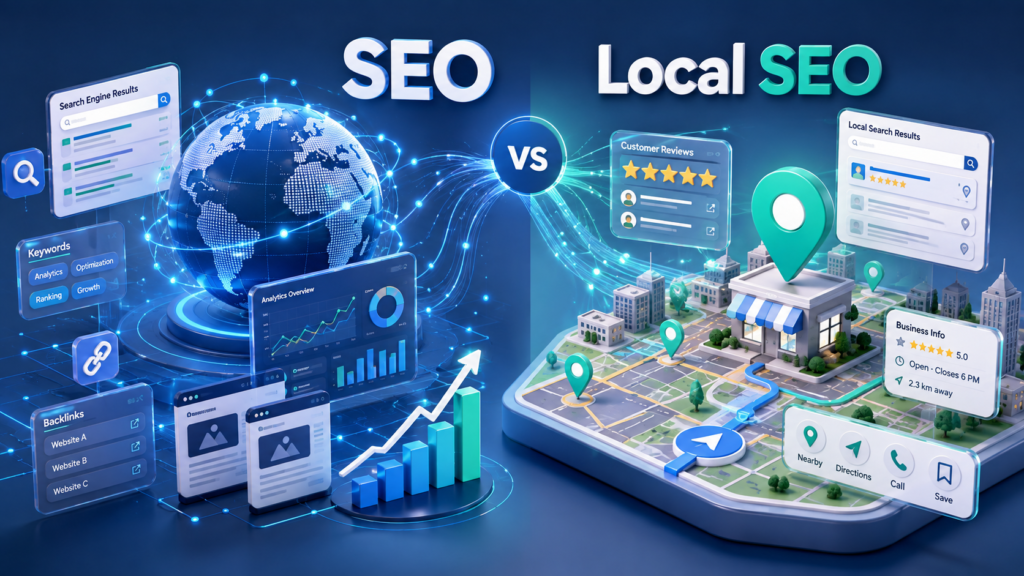
When people search online, they expect to find the most relevant answers within seconds. Businesses that appear at the top of search results usually receive more visitors, leads, and customers. However, not every business needs the same search strategy. Some want to reach customers across different regions, while others mainly serve people in a specific location.
Understanding SEO vs local SEO helps businesses choose the right approach for their goals. Although both strategies focus on improving visibility in search engines, they work in different ways and target different audiences. Knowing these differences can help you invest your time and resources more effectively.
Understanding SEO vs Local SEO
The discussion around SEO vs local SEO begins with understanding what each strategy is designed to achieve.
Search Engine Optimization (SEO) is the process of improving a website so it ranks higher in search engine results for relevant keywords. It focuses on increasing organic traffic by making a website more valuable, informative, and technically optimized. SEO is suitable for businesses that want to reach customers across cities, states, or even internationally.
Local SEO, on the other hand, focuses on helping businesses appear in searches related to a specific location. It is especially useful for companies that serve customers within a certain city or region. For example, when someone searches for “coffee shop near me” or “best dentist in Chicago,” search engines prioritize businesses that are close to the user’s location.
The main difference is simple. SEO targets a wider audience, while Local SEO targets nearby customers who are more likely to visit a physical location or request a local service.
How Traditional SEO Works
Traditional SEO focuses on improving a website’s authority and relevance for search engines. The goal is to rank for keywords that users search regardless of where they are located.
This process includes creating valuable content, improving website speed, optimizing page titles and descriptions, building high-quality backlinks, and ensuring a smooth user experience. Search engines evaluate these factors to determine whether a website deserves a higher ranking.
Businesses offering SEO Services often help companies build long-term online visibility by developing keyword strategies, improving technical performance, and creating useful content. This approach works well for companies that sell products or services across the United States or even globally, where attracting visitors from multiple locations is more important than focusing on a single city.
Unlike local optimization, traditional SEO places greater emphasis on overall website authority and content quality rather than physical business location.
How Local SEO Focuses on Nearby Customers
Local SEO is designed for businesses that depend on customers from a specific area. Restaurants, clinics, salons, repair companies, law firms, and local retailers are some of the businesses that benefit most from this strategy.
Instead of targeting broad searches, Local SEO helps businesses appear in location-based searches. Search engines consider several local signals, including business listings, customer reviews, accurate contact information, location relevance, and map listings.
A properly optimized business profile helps customers quickly find important details such as business hours, phone numbers, directions, and customer ratings. These details make it easier for people to choose a business with confidence.
Another important aspect of Local SEO is consistency. Business information should remain accurate across directories and websites so search engines trust the information they display.
Key Differences Between SEO and Local SEO
Although both strategies aim to improve search visibility, they differ in several important ways.
The first difference is the target audience. SEO focuses on users regardless of their location, while Local SEO targets people searching within a specific geographic area.
The second difference is ranking factors. Traditional SEO relies heavily on website content, technical optimization, backlinks, and keyword relevance. Local SEO adds additional factors such as business location, online reviews, local citations, and proximity to the searcher.
Another difference is search intent. Someone searching for “how to improve website traffic” is usually looking for information, while someone searching for “plumber near me” is often ready to contact a local business immediately.
Finally, the competition also varies. Traditional SEO may involve competing with websites from many regions, while Local SEO focuses on competing with businesses operating within the same local market.
Understanding these differences helps businesses choose the strategy that aligns with their audience and growth objectives.
Which Strategy Is Right for Your Business?
Choosing between SEO and Local SEO depends on your business model rather than which strategy is better.
If your business sells digital products, provides online services, or targets customers across multiple regions, traditional SEO is usually the better choice. It helps attract visitors from a broader audience and supports long-term brand growth.
If your business has a physical location or serves customers within a specific city or region, Local SEO is often more effective. It connects your business with people actively searching for nearby products or services.
Many businesses eventually combine both strategies. A company may use traditional SEO to publish educational content while also optimizing for local searches to attract customers in nearby areas. This balanced approach allows businesses to increase visibility on multiple levels without limiting their growth potential.
Businesses looking for Local SEO Services often benefit from this combined strategy because it supports both local customer acquisition and broader online visibility.
The Future of Search Optimization
Search engines continue to become smarter, and user behavior is constantly changing. Artificial intelligence, voice search, and personalized search results are influencing how websites are ranked.
As search technology evolves, businesses need strategies that focus not only on keywords but also on user experience, content quality, and search intent. Modern optimization is becoming more data-driven and customer-focused than ever before.
Many companies are also exploring AI SEO Services to improve content planning, keyword research, technical optimization, and performance analysis. While AI can make many tasks more efficient, successful search optimization still depends on creating valuable content that genuinely helps users.
When comparing SEO vs local SEO, it is important to remember that neither strategy replaces the other. They serve different purposes and support different business goals. The right choice depends on where your customers are, how they search, and what kind of business you operate.
Businesses that understand these differences can create a stronger online presence, attract more qualified visitors, and build lasting relationships with their target audience. Instead of choosing the most popular strategy, focus on the one that matches your objectives and customer needs. A well-planned search optimization strategy will always deliver better long-term results than trying to reach everyone with a single approach.