
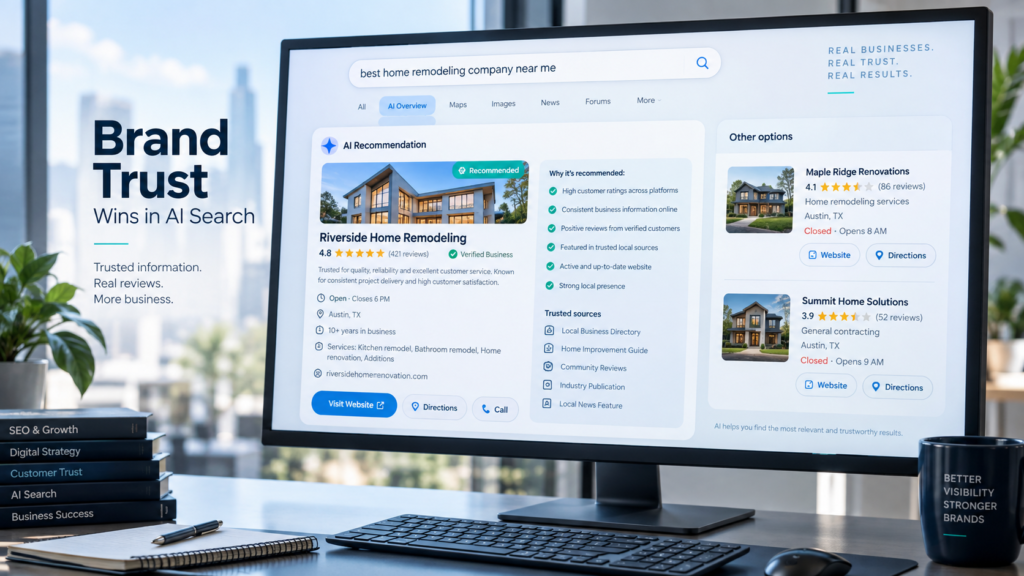
When people search for a business, they no longer rely only on traditional search results. They increasingly ask AI platforms questions such as which company to choose, which service provider is reliable, or which brand is worth considering. The important shift is that AI does not simply match a keyword with a webpage. It evaluates information, compares sources, identifies patterns, and attempts to provide an answer it can confidently stand behind.
That creates a new challenge for businesses. Your website may rank well for important searches, but if AI systems cannot establish that your brand is credible, consistent, relevant, and genuinely useful, another business may be selected instead. The issue is no longer just visibility. It is whether your brand provides enough trustworthy signals for AI systems to understand and recommend it.
Why AI Trust Matters More Than Visibility
Traditional search visibility and AI visibility are connected, but they are not exactly the same.
A search engine can return a webpage because it appears relevant to a query. An AI system answering a recommendation-based question has a different problem to solve. It needs to determine which information appears dependable enough to include in its response.
Imagine someone asks:
“Which local dental clinic is known for quality cosmetic dentistry?”
An AI system may consider multiple signals before mentioning a business. It can look at the company’s website, service information, business profiles, reviews, third-party references, professional information, and consistency across different sources.
This means a brand can have strong rankings without necessarily becoming a preferred source for AI-generated recommendations.
Trust is built through the combined strength of your digital presence. When different sources consistently describe your business, services, expertise, location, and reputation, AI has more evidence from which to understand your brand.
What Creates Brand Trust in AI Search?
Brand trust in AI search is not created by adding a single technical element to a website. It develops from a broader ecosystem of consistent and verifiable information.
One of the strongest signals is consistency. Your business name, services, location, contact information, expertise, and positioning should make sense wherever customers encounter your brand. Major differences between your website and other business profiles can create uncertainty about which information is accurate.
Content quality also matters. A website filled with generic statements provides little evidence of expertise. Stronger content explains subjects clearly, addresses genuine customer questions, demonstrates practical knowledge, and provides enough context for readers to understand why the information can be trusted.
Reputation adds another layer. Reviews, mentions, citations, professional references, industry publications, and other independent signals can help establish that a company exists beyond its own website.
The goal is not to manufacture trust signals. It is to create a digital footprint that naturally demonstrates credibility.
How Your Website Influences AI Recommendations
Your website remains one of the most important sources of information about your company because it gives search systems a structured understanding of your business.
However, simply publishing more pages does not automatically improve trust.
A trustworthy website should clearly communicate who the business serves, what it offers, where it operates, and why customers should consider its expertise. Service pages should answer real questions instead of repeatedly inserting commercial phrases.
For example, a healthcare provider should not only state that it offers a particular treatment. A useful page can explain who the treatment is suitable for, what the process involves, common considerations, expected outcomes, and questions patients frequently ask.
This type of content gives both users and AI systems meaningful context.
Author information can also strengthen credibility when appropriate. Identifying qualified authors, reviewers, practitioners, or subject-matter experts can make the origin of important information clearer.
Technical clarity matters too. Clear navigation, logical page structures, descriptive headings, internal linking, structured data where appropriate, and accessible content make it easier for search systems to interpret the website.
The Role of Online Reputation
Your reputation does not exist only on your website.
Customers may encounter your business through review platforms, business directories, social profiles, industry websites, news publications, professional organizations, and other external sources. These references contribute to the broader picture surrounding your brand.
This is especially important when an AI system is deciding whether a business appears credible enough to mention.
Consider two companies offering similar services. Company A has a detailed website but very little independent information about it. Company B has a strong website, consistent business information, authentic customer feedback, industry references, and a recognizable presence across relevant platforms.
Even if both companies publish similar service pages, Company B provides a stronger body of evidence.
That does not mean businesses should chase mentions everywhere. Relevance is more important than volume. A credible reference from an appropriate industry source can be more meaningful than dozens of unrelated directory listings.
Why Consistency Is an AI Trust Signal
AI systems need to connect information from different sources.
If your website says you operate in one location but business profiles list another, or if different platforms describe your services differently, the system has to resolve those contradictions.
Consistent information makes that process easier.
Your core business details should therefore remain accurate across relevant digital properties. This includes your business name, address, phone number, service categories, operating areas, website information, and other important business attributes.
Consistency also applies to brand positioning.
If your website presents your company as a specialist in one field while third-party sources describe you primarily as something completely different, AI may have difficulty determining what your business is actually known for.
A clear and consistent identity makes your entity easier to understand.
How Content Builds Evidence of Expertise
High-quality content should do more than target search terms.
It should demonstrate that your business understands the problems its customers are trying to solve.
That means answering complicated questions, explaining industry terminology, addressing common misconceptions, discussing important considerations, and providing practical guidance.
For example, an accounting firm could create content explaining tax planning decisions, common filing mistakes, business deductions, and regulatory considerations. A home-service company could explain how customers can identify common problems, compare solutions, and understand when professional assistance is necessary.
This creates a knowledge footprint around the brand.
SEO Services can support this process by improving the structure, discoverability, internal relationships, and search relevance of that content, but the underlying information still needs to be genuinely useful.
The strongest strategy is not to create content simply because a keyword has search volume. Instead, identify the questions customers ask before, during, and after choosing a service—and provide authoritative answers.
How AI SEO Changes the Optimization Approach
AI SEO requires businesses to think beyond traditional rankings and focus on how their information can be interpreted, connected, summarized, and cited by AI-driven search experiences.
That does not mean abandoning conventional optimization. Technical SEO, useful content, strong pages, internal linking, authority, and user experience still matter.
The difference is that content needs to be created with broader information retrieval in mind.
A page should make its primary topic obvious. Important claims should be supported with credible information where appropriate. Related concepts should be connected naturally. Questions should receive direct answers rather than being buried beneath unnecessary introductions.
Businesses should also think about entities rather than isolated keywords. AI systems need to understand relationships between a company, its services, locations, expertise, people, products, and reputation.
The objective is to build a coherent information ecosystem around the brand.
Local Signals Can Influence AI Visibility
For businesses serving specific geographic markets, location becomes another important part of the trust equation.
Someone asking an AI platform for “the best emergency plumber near me” is not looking for a globally relevant company. They want businesses that actually serve their area.
This is where Local seo becomes important. Accurate business profiles, location-specific service information, genuine customer reviews, consistent business details, and relevant local references can help establish geographic relevance.
A business should make it easy to understand where it operates rather than creating thin location pages with nearly identical content.
Useful local content can explain the services available in a particular market, local customer considerations, service areas, response expectations, and other information that genuinely helps people in that community.
For brands operating across the United States market, the same principle applies at scale: geographic relevance should be clear, accurate, and supported by meaningful local signals rather than artificial location targeting.
How to Build Long-Term AI Trust
There is no guaranteed formula that forces an AI system to recommend a particular company. AI-generated answers can change, sources can change, and different platforms may evaluate information differently.
The practical approach is to strengthen the evidence surrounding your brand.
Start by auditing your website and major business profiles for inconsistencies. Review your most important service pages and determine whether they genuinely demonstrate expertise. Examine your reviews and reputation across relevant platforms. Identify missing information that customers repeatedly search for. Improve the connections between related topics on your website.
Then look beyond your own domain.
Ask whether respected websites, professional organizations, industry publications, and relevant local sources provide independent evidence that your business is legitimate and knowledgeable.
Most importantly, avoid shortcuts designed only to manipulate AI systems. Mass-produced content, fabricated reviews, misleading claims, and artificial mentions can undermine the very trust you are trying to establish.
The brands most likely to remain visible across changing search experiences will be the ones that consistently provide useful information and maintain a credible presence across the web.
Trust Is Becoming Part of Search Visibility
Search is moving from a system where people primarily discover webpages toward experiences where systems increasingly interpret information and provide answers.
That makes trust a strategic business asset.
Brand trust in AI search is built through consistency, expertise, reputation, useful content, accurate business information, and credible external evidence. None of these signals works in isolation. Together, they create a clearer picture of who your business is and why it deserves consideration.
Your competitor does not necessarily need better services to win the answer. If their digital presence gives AI stronger evidence of relevance and credibility, they may simply become easier to recommend.
The businesses that recognize this shift early can focus on something more valuable than chasing individual rankings: building a brand that search engines, AI systems, and customers can confidently understand and trust.